[INFO] Department Regulations

User avatar
Owen Ryland
Inspector
Posts: 616
Joined: Mon Jul 10, 2017 4:28 pm

[INFO] Department Regulations

Post by Owen Ryland »

Image
SAN ANDREAS HIGHWAY PATROL
DEPARTMENT REGULATIONS
PREFACE

This guide has been designed to assist the San Andreas Highway Patrol in Its day-to-day operations. The policies and procedures described in this manual are set by the Highway Patrol Administration and deemed necessary for proper department operation. When properly developed and implemented, a policy-procedure manual provides staff with the information to act decisively, consistently, and legally. It also promotes the confidence and professional conduct among staff. No exceptions are to be made to this SOP without consent from a member of Highway Patrol Administration or Valrise Community Management.

TABLE OF CONTENTS

  • Section 1 - Department Structure
1.1 - Primary duties
1.2 - Chain of Command
1.3 - Jurisdiction & Regulations
1.4 - State Law
  • Section 2 - Uniform, Personal Appearence & Weaponry Standards
2.1 Uniform Policy & Dress Code
2.2 Personal Appearence standards
2.3 Weaponry standards
  • Section 3 - Duty regulations
3.1 Usage of weaponry
3.2 Traffic stops
3.3 Pursuit procedure
3.4 Radio Codes
  • Section 4 - Highway Operations & Vehicle Management
Introduction
4.1 What is Structure Identification
4.2 What is Vehicle Fleet Management
4.3 State Traffic Law
4.4 Traffic Accident Management
4.5 Checkpoint Management
4.6 Clock Face Analogy
  • Section 5 - SECTION 5 - Motorbike & Vehicle Operations
  • Section 6 - Traffic Operations & Incident Management


Signed,
SAHP Command Staff
Image
Inspector Owen Ryland
Special Enforcement Bureau
San Andreas Sheriffs Department
''Tradition of service''

User avatar
Owen Ryland
Inspector
Posts: 616
Joined: Mon Jul 10, 2017 4:28 pm

Re: [INFO] Department Regulations

Post by Owen Ryland »

SECTION 1: INTRODUCTION

San Andreas Highway Patrol is a state law enforcement responsible for maintaining safety and order on San Andreas' highways and roads. Primary duties include:

Traffic enforcement: enforcing traffic laws, issuing citations for violations, and ensuring the safe flow of traffic on state highways and roads.
Vehicle and Driver safety: responding to and investigating motor vehicle accidents to determine causes and prevent future accidents.
Accident investigation: responding to and investigating traffic accidents to determine causes and prevent future incidents.
Emergency assistance: providing aid during emergencies to other law enforcement/state government agencies (e.g. SADOT), governmental events/convoys.
Crime prevention and enforcement: addressing crimes that occur on highways such as theft, drug releated crimes, racing, tax evasion.
Public education & affairs: promoting safe driving practices through outreach programs and community engagement.
Specialized units operations.

1.2 CHAIN OF COMMAND


Rank structure:

SAHP COMMISSIONER'S OFFICE
Commissioner
Deputy Commissioner
Assistant Comissioner
    
SAHP CHIEF'S OFFICE
Chief
Assistant Chief
    
SAHP COMMAND STAFF
Captain
    
SAHP PATROL SUPERVISORS
Lieutenant
Sergeant
    
SAHP SENIOR PATROL TROOPERS
Senior Trooper
    
SAHP PATROL TROOPERS
Trooper


1.3 JURISDICTION & REGULATIONS


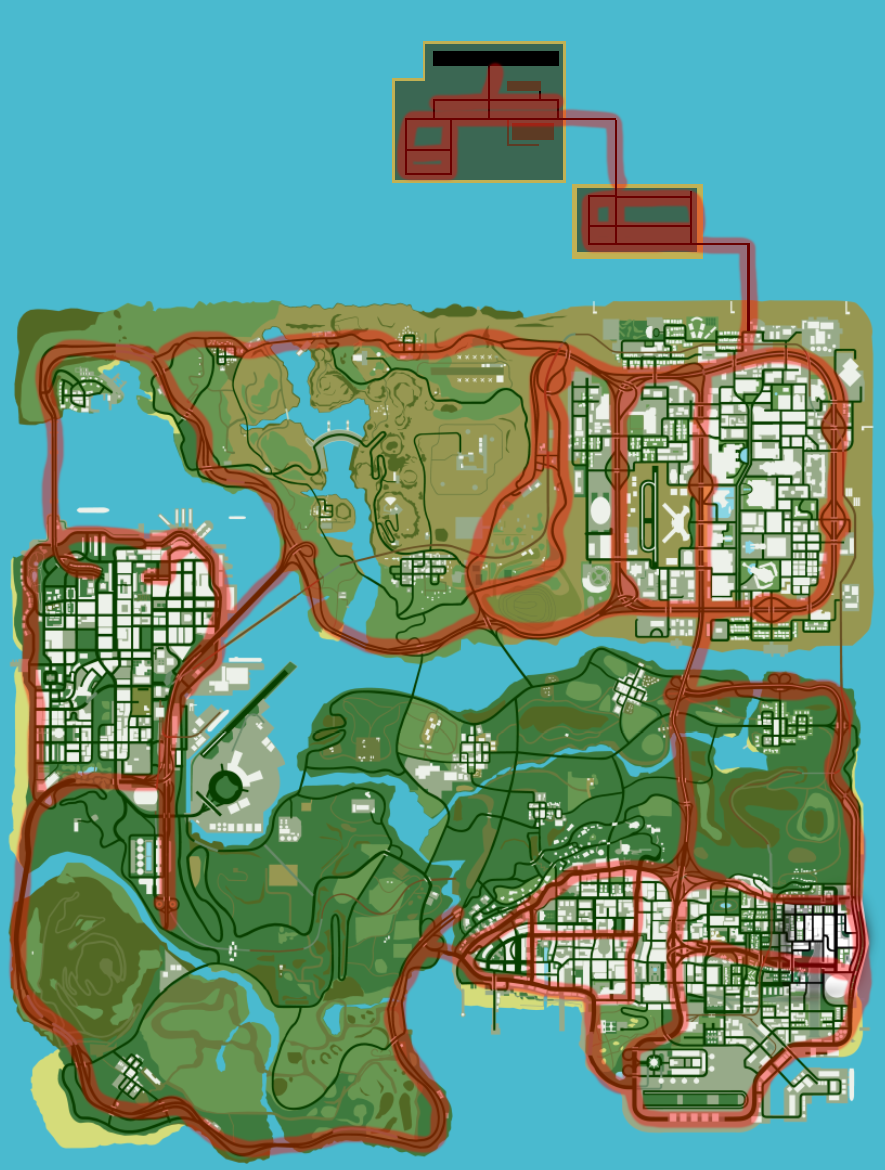
San Andreas Highway Patrol has jurisdiction primarily over State highways, freeways and main roads both within the county and the city. Remain out of inner city areas such as Idlewood, Ganton, Jefferson etc, unless direct contact with suspect(s) has been made on our service area and the encounter has led to area, that is out of our jurisdiction. In this case - Trooper has to inform law enforcement agency responsible for given area about the incident and only assist in the situations only as long as the objective has been reached.
Highway Patrol may respond and operate in other State Government agencies jurisdiction when we are specifically requested for such matters (e.g. SAPD, SASD, SAFD).


Jurisdiction map:
Spoiler
Image

REGULATIONS:

- You are to direct everyone by rank, not first name.
- You are to remain professional on the radio and on the field at all times on the line of duty.
- You will respect superiors when given an order. You feel the order is not right, follow the chain of command.
- When on a traffic stop, you are to introduce yourself by rank, last name, San Andreas Highway Patrol.
- All Troopers must serve only within our given jurisdiction unless approved otherwise by the Commissioners Office. Failure to obey this point results in consequenses.
- Every Trooper's gear and uniform has to be tidy, functioning and at highest possible standard in order to gain maximum efficiency on the line of duty.
- SAHP does not have authority over other law enforcement agencies.


1.4 STATE LAW

All members of the San Andreas Highway Patrol must have the basic knowledge of San Andreas' State Law.
Access the State Law here.


Signed,
SAHP Commissioner's Office
Image
Inspector Owen Ryland
Special Enforcement Bureau
San Andreas Sheriffs Department
''Tradition of service''

User avatar
Owen Ryland
Inspector
Posts: 616
Joined: Mon Jul 10, 2017 4:28 pm

Re: [INFO] Department Regulations

Post by Owen Ryland »

SECTION 2: UNIFORM, PERSONAL APPEARANCE & WEAPONRY STANDARDS

2.1 UNIFORM POLICY & DRESS CODE
All Troopers are required to present themselves in a professional and authoritative manner at all times while on duty. The wearing of the department-issued uniform is a direct representation of the San Andreas Highway Patrol and shall be maintained to the highest standard. The following regulations outline uniform selection, appearance and compliance standards for all sworn personnel.

2.1.1 UNIFORM CLASSIFICATION:
The San Andreas Highway Patrol recognizes three (3) authorized uniform classes for sworn troopers. Uniform class selection shall be appropriate to the nature of duty assignment and environmental conditions, unless otherwise directed by a watch supervisor or a watch commander.

Class A Uniform:
  • Long-sleeve collared uniform shirt in the department-issued color, worn without a tie.
  • Class A may be worn during standard patrol operations at the Trooper's discretion and is required for formal appearances, court testimony, press engagements, ceremonies and any duty where a watch commander / commanding officer designates Class A as mandatory.
  • Shall be neatly pressed and free of visible wear, staining or damage at all times.
  • All issued insignia, badge, and rank insignias must be properly affixed and visible.
  • Motor Trooper Uniform: Troopers assigned to motorcycle patrol unit are expected to wear the department-issued motor trooper uniform, consisting of a long-sleeve uniform shirt, department-issued riding boots and appropriate riding attire. Motor troopers are required to wear a department-approved helmet at all times while operating a motorcycle, without exception. Failure to comply with the helmet requirement while on motorcycle duty may result in immediate corrective action.
Class B Uniform:
  • The Class B uniform consists of the department-issued State Trooper leather jacket worn over the standard uniform shirt, authorized for use during cold weather conditions or as designated by command staff.
  • The leather jacket shall bear the department-issued "STATE TROOPER" designation and must be worn in accordance with department uniform standards (clean, properly fitted and free of visible damage or unauthorized modifications).
  • Personnel wearing the Class B uniform remain subject to all rank insignia and badge display requirements applicable to the Class A and Class C uniforms.
  • The Class B uniform is not authorized as a replacement for the Class A uniform during formal appearances, court testimony, ceremonies, unless explicitly approved by command.
  • Any patches, pins, or attachments not issued or approved by the department are strictly prohibited on the Class B leather jacket.
Class C Uniform:
  • Short-sleeve collared uniform shirt in the department-issued color.
  • Authorized for standard patrol duties, field operations and routine assignments.
  • Subject to the same standards of cleanliness, condition and proper insignia placement as the Class A uniform.

2.1.2 CADET & PROBATIONARY UNIFORM REGULATIONS:
Cadet Uniform: Cadets enrolled in the SAHP Training Academy are issued a distinct uniform separate from the Class A, Class B and Class C classifications. The cadet uniform shall be worn exclusively throughout the duration of the academy program. Cadets are not authorized to wear sworn trooper uniforms until they have been officially sworn in and graduated from the academy.


Probationary Trooper Uniform Requirements: Troopers serving within their designated probationary period are required to wear the Class A long-sleeve uniform at all times while on duty, regardless of weather conditions or personal preference. This requirement remains in effect for the full duration of the probationary period and may only be modified with explicit written authorization from the Trooper's chain of command. Probationary Troopers found to be in violation of this directive may be subject to corrective action.


2.1.3 GENERAL UNIFORM STANDARDS:
  • All Troopers shall wear the standard issued Highway Patrol uniform (short or long sleeved) in accordance with the class designations outlined above.
  • The department-issued Trooper campaign hat is mandatory for all sworn personnel while on patrol, regardless of uniform class. The hat shall be worn straight and level on the head, positioned approximately one inch above the eyebrows, centered between the ears. It must be properly fitted, clean and in good condition at all times.
  • Tactical body armor (outer vest carrier) is not authorized during routine patrol operations. Personnel may only wear external body armor during active shooter situations, barricaded subject incidents, heavy shootouts, bank robberies, jewelry heists or other high-risk tactical operations and only when directed to do so by a supervisor or above. All other times, Troopers must adhere to proper attire consisting of a clean uniform with the under vest worn and shield badge visible at all times.
  • The department-issued high-visibility traffic vest is mandatory during traffic details and authorized checkpoints. Outside of these assignments, the traffic vest is not required but is strongly recommended during nighttime hours between 19.00 and 05.00 for maximum visibility. The traffic vest is required for Motor Troopers operating a motorcycle during night hours. Outside of the circumstances listed above, the traffic vest is not authorized for use during regular patrol operations and must remain secured in the Trooper's vehicle.
  • Insignias shall be worn in accordance with rank designation as prescribed by department regulations.
  • Troopers are authorized to wear uniforms pertaining to a sub-division and/or specialized unit exclusively while actively performing duties within that division. Wearing sub-divisional uniforms outside of the assigned operational context is not permitted unless authorized by department command staff.
  • Plain clothes duty may be authorized by a member of Command staff or above when a speed enforcement operation or racing detail is requested, or when a Trooper is assigned to a special detail requiring civilian attire.
  • All Troopers are issued a department-issued body-worn camera (bodycam) upon assuming duty, automatically activated upon starting your shift.
  • No unauthorized attachments, pins or accessories are permitted on the uniform. The only authorized exceptions are black sunglasses and the American flag pin, which must be placed directly below the badge.
  • All gear and uniform items issued to a Trooper must be maintained in a tidy, fully functional condition and held to the highest possible standard at all times.

2.2 PERSONAL APPEARANCE STANDARDS
The San Andreas Highway Patrol holds its personnel to a high standard of professional appearance, consistent with the image and integrity of the department. The following regulations apply to all sworn personnel while in uniform or on duty in any capacity.

2.2.1 Facial Hair:
Facial hair is permitted provided it is neat, clean and well-groomed at all times. Beards, mustaches and goatees are allowed but must not exceed one-half inch in length and must not interfere with the proper seal of any department-issued protective equipment. Sideburns shall not extend below the mid-point of the ear. Excessively decorative facial hair is not authorized. Supervisors retain the authority to counsel personnel whose facial hair does not meet these standards.

2.2.2 Tattoos:
Tattoos visible while in uniform must not depict content that is obscene, offensive, discriminatory or gang-affiliated. Tattoos on the face, neck above the collar line or hands are not authorized. Tattoos on the forearms and lower arms visible during Class C duty are permitted provided they conform to the content standards above. Non-compliant tattoos must be covered during on-duty hours. Any tattoo deemed in violation by command staff must be covered at all times or removed at the personnel member's own expense.

2.3 WEAPONRY STANDARDS
All sworn personnel of the San Andreas Highway Patrol are issued department-authorized weapons upon assuming duty. All issued weapons must be maintained in a clean, fully operational condition at all times. Personnel are responsible for the proper handling, storage and accountability of all weapons assigned to them. Misuse, negligence or unauthorized modification of any department-issued weapon is strictly prohibited and subject to disciplinary action.

All Troopers are issued the following weapons as standard duty belt equipment:
  • Baton
  • X26 Taser (CEW) Conducted Energy Weapon.
  • Sig Sauer P226 Service Pistol (Desert Eagle).
The following weapons are assigned to each Trooper's patrol vehicle and are to remain secured within the vehicle when not in active use:
  • Remington 870 Shotgun.
  • Beanbag Shotgun.
  • Colt M4 Carbine.
Signed,
SAHP Commissioner's Office
Image
Inspector Owen Ryland
Special Enforcement Bureau
San Andreas Sheriffs Department
''Tradition of service''

User avatar
Owen Ryland
Inspector
Posts: 616
Joined: Mon Jul 10, 2017 4:28 pm

Re: [INFO] Department Regulations

Post by Owen Ryland »

SECTION 3 - DUTY REGULATIONS

3.1 USEAGE OF WEAPONRY

Image

3.1.1 WEAPON REGULATIONS
The San Andreas Highway Patrol entrusts sworn State Troopers with various equipments. Weapons in this case are categorized on the folowing categories:
  • Less than lethal.
  • Lethal.
  • Military grade.
Less than lethal is used to force the suspect into a situation where he can be easily placed in custody. Batons must never be aimed at the head of a suspect as they can quickly become lethal, the same goes for the taser.
Less than lethal weapons:
  • AETCO 42" Baton or Rapid Containment Baton (RCB) as alternative weapon.
  • Cell buster OC Pepper Spray device.
  • Taser x2 Defender
  • SAHP issued Beanbag Shotgun
Lethal weaponry is used to bring down a ssupect, which has failed to comply and is now a danger to himself and others. Lethal weaponry must be used accordingly to the scale of force. Be aware, that weapons in this category can inflicht serious bodily damage.
Lethal weapons:
  • Smith & Wesson M&P pistol.
  • Remington 870 shotgun.
  • Heckler & Koch MP5 submachine gun.
Military grade weaponry or Heavy Weapons are used to bring down suspects which are using heavy weaponry themselves. Heavy weaponries are only allowed, when you're outnumbered or the Suspect is using it aswell. Troopers are obligated to store the heavy weaponry in the trunk ((rack)) of your vehicle. Probationary Troopers can make use of the Heavy Weaponry when ordered from a Sergeant or higher. Special Response Team members are allowed to carry heavy weaponry on their own discretion, but need to stick to the regulations above.
Heavy weaponry:
  • AR-15 Assault rifle.
  • Barrett M82A1 sniper rifle. (Only to be used by SRT Members)

3.2 TRAFFIC/FELONY STOPS
When initiating a traffic stop, you communicate with the driver using the megaphone or the police lights for the vehicle to pullover.

Firstly ensure that you are not stopped on a intersection, on a tight corner or other dangerous person, if so, communicate with the driver that they must stop elsewhere.

When the vehicle comes to a stop, assure you align the center of your vehicle with the left tail light of the other vehicle to ensure your safety when out of the vehicle, and standing next to the other vehicle. Before exiting your vehicle make sure to make dispatch is aware of your traffic stop by communicating with them over the radio.

When approaching the vehicle, eye for the suspicious or dangerous objects either in the driver's hand or in the back seat, as you approach the rear of the vehicle, tap the left tail light with one of your hands to leave your fingerprints on the vehicle.

Then approach the driver, if you spot nothing dangerous or suspicious, stay slightly behind the driver, behind his left shoulder when asking him questions. This is the most tactically advantegous position. In this position you are the least vulnerable to attack by the driver or occupant of the vehicle.

Additionals must always line up behind the lead vehicle.

To identify your vehicle stop, every State Trooper must adhere to the following form: Location, vehicle type & color, plate of the vehicle, occupants of vehicle (how many/describtion).

Felony stop is a stop where you are already aware of the danger of a suspect, and are ready to arrest a suspect, this type of stop is preferably executed by more than one vehicle, but could be done alone.

This stop is done simply by ordering the vehicle to stop, and putting oneself in a tactically adventageous position such as slighly sideways, with the door open. You withdraw your firearm and order the occupant of the vehicle to drop their vehicle keys out of the window, slowly, and get out of the vehicle as they are to be ordered to approach the police vehicles backward, where they are to kneel or laya down to be detained.

Additionals vehicles to the lead vehicles always line up next to one for a clear fireline.


3.2 PURSUIT PROCEDURES
During a pursuit, operate vehicles in a straight line following the vehicle, do NOT overtake, unless the cruiser in front of you cannot continue the pursuit or would lose a suspect. If there is a High Speed Vehicle that is evading, you may request for a High Speed Unit to assist.

The closest vehicle to the suspect always has to lead the pursuit and the officer in the passenger's seat MUST keep the radio updated all the time, however. Once a HSU engages and joins the pursuit, it takes the lead.

Safety first: Troopers should prioritize safety, avoiding excessive speeds and dangerous maneuvers.
Use of equipment: Deploy spike strips only when safe and appropriate. Other participants during the pursuit must be informed about spike deployment.
Coordination: Maintain communication with dispatch and other units, coordinating interventions and backup as this assures effective and most less lethal result for all possible participants.


3.3 RADIO CODES
10-3 - Stop Transmitting
10-4 - Understood
10-7- Out of service, unavailable for emergency calls.
10-7B - Out of service, available for emergency calls. (aka paperwork)
10-8 - In service, available for emergency calls.
10-12 - Large gathering of individuals
10-14 - Escort
10-15 - Criminal in custody
10-16 - Go pick the prisoner / Requesting a prisoner pickup
10-19 - Go to your station / Returning to the station
10-20 - Report your location / My location is ___
10-22 - Disregard last transmission
10-34 - Resume Normal Broadcast
10-35 - Confidential Information
10-39 - Message Delivered
10-53 - Officer down
10-60 - Felony stop
10-66 - Suspicious person, requiring assistance
10-76 - Responding to a location
10-80 - Active pursuit, location updates to follow
10-84 - Estimated time of arrival (ETA)
10-86 - Traffic Check/Stop
10-97 - Arrived on scene
Code 1 - Acknowledge Call/Respond Over Radio
Code 2 - Routine Call, No Lights or Siren
Code 2-H - Priority Call, No Lights or Siren
Code 3 - Emergency Call, Lights and Siren
Code 4 - No Further Assistance Needed
Code 5 - Uniformed officers stay away (stakeout)
Code 6 - Out of Car on Investigation
Code 6A - Out of Car on Investigation, Requires Assistance
Code 6C - Out of Car on Investigation, Suspect is Wanted
Code 6G - Out of Car on Investigation, Gang Activity
Code 7 - Meal Break
Code 8 - Fire Alarm
Code 9 - Requesting additional units, no lights or siren
Code 9A - Requesting additional units, sirens and lights on
Code 10 - Request to Clear Frequency for Crime Broadcast
Code 12 - False Alarm
Code 14 - Resuming regular patrol, available for callouts
Code 30 - Officer in danger, requires immediate assistance
Code 37 - Vehicle is Reported Stolen
Code 77 - Caution, Possible Ambush
Code 99 - Emergency
Code 100 - In Position to Intercept
137 - Riot
187 - Homicide
207 - Kidnapping
211 - Armed Robbery
240 - Assault
242 - Battery
261 - Rape
311 - Indecent Exposure
390 - Intoxicated Person
415 - Disturbance
417 - Person With a Gun
459 - Burglary
470 - Forgery
480 - Hit and Run
487 - Grand Theft
502 - Driving Under the Influence (DUI)
LF(U) - Lethal Force (Used)
ETA - Estimated Time of Arrival
VC - Visual Contact
TC - Traffic Collision
TS - Traffic Stop
SU - Suspect

CODE RED - State Wide emergency - All units stop what you are doing, and report to SAHP station, unless told otherwise.
CODE ORANGE - City Wide emergency
CODE PURPLE-P - Possible Gang War
CODE PURPLE-A - Confirmed Gang War

Signed,
SAHP Commissioner's Office


Image
Inspector Owen Ryland
Special Enforcement Bureau
San Andreas Sheriffs Department
''Tradition of service''

User avatar
Weston Lockeheed
Sheriff's Lieutenant
Posts: 813
Joined: Sun Aug 26, 2018 9:53 pm
Serial Number: 10238
Other Characters: South Africa

Re: [INFO] Department Regulations

Post by Weston Lockeheed »

SECTION 4 - Highway Operations & Vehicle Management


4.1 What is Structure Identification

It is vitally important for a Highway Trooper to be able to identify highway structures as part of their training process. Being able to identify such structures aids in the location process and ensures precision and accuracy when locating a trooper. The San Andreas highway road network has a variety of road structures that serve different functions to ensure smooth traffic flow.


Intersection

An intersection refers to a section of the road wherein two or more roads join to meet at a particular point. An example of such would be the Las Venturas Intersection near Randolph Estate.
Image
Interchange

An interchange is a complex road network where multiple road networks cross paths to lead to various destinations. This is not to be confused with an intersection, as at no point do the roads meet at a single point. The Mulholland Interchange is a perfect example of such.
Image
Flyover / Overpass

A flyover or overpass is an elevated bridge carrying a roadway or railway line at a different gradient. The Harry Goldway Park highway is an example of such.
Image
Variable Message Sign (VMS)

A Variable Message Sign (VMS) is an electronic road sign programmable in real time to inform road users of expected road hazards. Such signs are commonly found along the Los Santos–Las Venturas highway stretch and can be used via /highwaysign text and /highwaysign size.
Image
    
4.2 What is Vehicle Fleet Management

Vehicle fleet management refers to the consistent oversight of police vehicles, ensuring they are safe to use, determining which vehicles are to be deployed during police pursuits, and identifying which vehicles are suited for specific situations.

Various SAHP cruisers are suited for different functions and are limited in use based on rank. The following vehicles are approved for regular Trooper patrol:
  • Wayfarer – BADGER: Most suited for motorcades; not practical in pursuits due to low speeds.
  • NRG – BADGER: Best suited for high-speed pursuits; not effective against heavy vehicles such as semi-trucks.
  • Premier – HORNET: Equipped with Federal Signal Arjent lightbar. Versions without lightbar and with or without ram bar are approved for regular use.
    (Arjent Lightbar)
    Image
        
  • 2-Door Rancher – HORNET (copcarru): Fitted with a Grappler Police Bumper. Free for all troopers to use.
  • Buffalo – HORNET: Well-suited for highway high-speed pursuits; does not handle well in city chases.
  • Bullet / Turismo: Off limits.
  • Classic Car Collection: Off limits unless permitted by Sergeant+.

Grappler Function

A police grappler functions to immobilize a suspect vehicle by deploying a nylon fabric that entangles the rear axle and wheels. The weight of the police vehicle then acts as an anchor, slowing the suspect vehicle down.

Video demonstration:
https://youtu.be/mXUHeieBIfE


Mobile Digital Computer (MDC)

A Mobile Digital Computer is a ruggedized in-vehicle system connecting officers to dispatch and vital databases. It allows real-time access to calls, suspect and vehicle information, report writing, mapping, and report submission, improving officer safety and reducing radio traffic.
Image

Automated License Plate Recognition (ALPR)

ALPR systems automatically capture vehicle images and license plates, translating them into data while measuring real-time speed. In-game usage is available via /vehicleradar.
Image

4.3 State Traffic Law

Troopers must keep the following basic traffic laws in mind:
  • Headlights must be on between 18:00 and 08:00.
  • City speed limit: 100 km/h.
  • Highway speeds: Unlimited.
  • Rural speed limit: 160 km/h.
  • Correct parking requires two wheels on the roadway and two wheels on the pavement.

4.4 Traffic Incident Management

Traffic Incident Management refers to managing an MVA or Motor Vehicle Collision no matter the situation. This ensures the smooth flow of traffic, easing the path of emergency service workers in order for them to render speedily medical aid. Here are a few key factors to remember in managing a traffic accident.

  • Safety: Trooper and civilian safety is of the utmost importance, so this means cordoning off the scene of the accident through the use of barriers or your cruiser in order to prevent further accidents.
  • Radio Communication: Radio communication is the second vital step in which you radio for Fire & Medical Services to render medical aid. Also in this process you radio for further units be it other troopers or other LEO agencies for additional assistance.
  • Task Delegation: Task delegation is your next step in scene management. What this means is that you as the incident commander ought to delegate various tasks to various units on scene. That means one trooper or officer controls access to the scene of the accident only allowing emergency service workers. Another trooper prioritizes traffic rerouting as traffic needs to move along if possible. Another trooper would prioritize evidence collection by wearing nitrile gloves and collecting whatever may serve as evidence in an MVA. This could be broken glass bottles, cannabis joints etc. What a trooper may not do is interfere in a traffic accident scene that has clear elements of a shootout wherein there are bodies laying around. In that regard a trooper would have to contact the Detective Services of the San Andreas Police Department for further instructions.

4.5 Checkpoint Management

Checkpoint management refers to the standard procedure in which Traffic checkpoints are managed. Checkpoints serve as markers in which Law Enforcement Agencies enforce compliance on civilians as far as Traffic Law is concerned. Here are the key points to take away in Checkpoint management.
  • Legal Basis: Establish the legal basis of your checkpoint. What this means is that you set out to clearly state what the legal limits of your checkpoint can and cannot do. An example of such would be in a standard checkpoint, Troopers are not allowed to search any individuals personally without probable cause, that would be a violation of the 4th Amendment under civil rights. (The Fourth Amendment to the U.S. The Constitution protects individuals from unreasonable searches and seizures by the government) However troopers are allowed to search the vehicle’s trunk, wherein should illegal contraband be found on a civilian’s vehicle. A trooper then has legal basis/probable cause to conduct a personal search of the civilian.
  • Task Delegation:Task delegation is also important in a checkpoint as this allows for the easy flow of traffic. That means delegating troopers to MDC management, Barrier Operator, Trooper aid covering your six, and having a trooper on standby in a High Speed Vehicle (HSV) in case a civilian attempts to flee a Checkpoint.

4.6 Clock Face Analogy

Clock face analogy refers to military shorthand to refer to positioning relative to one’s position. This means that, like the hands on an analogue clock, the marker of 12 would mean in front of you, 3 would be to your righthandside, 6 would be behind you, and 9 would be on your left hand side. The figure below illustrates such:
  • 12 o’clock – In front
  • 3 o’clock – Right
  • 6 o’clock – Behind
  • 9 o’clock – Left
Image


Signed,
SAHP Commissioner's Office
Image
Image
(2nd Administration)FORMER SHERIFF & CURRENT LIEUTENANT WESTON LOCKEHEED
Central Patrol Division
San Andreas Sheriff's Department— "A Tradition of Service"

Image

Image
FORMER LIEUTENANT WESTON LOCKEHEED
Central Patrol Division
Commander, Academy Division
Supervisor, K9 Unit

San Andreas Highway Patrol — "Safety, Service and Security"

Image


(4th Administration)FORMER CHIEF OF POLICE WESTON LOCKEHEED
Central Patrol Division
Commander, SWAT
SOB COMMANDER

San Andreas Police Department— "To Protect & Serve"

Image

User avatar
Weston Lockeheed
Sheriff's Lieutenant
Posts: 813
Joined: Sun Aug 26, 2018 9:53 pm
Serial Number: 10238
Other Characters: South Africa

Re: [INFO] Department Regulations

Post by Weston Lockeheed »

SECTION 5 - Motorbike & Vehicle Operations


Purpose

This section serves to illustrate to prospective students the various formations that will be used by a trooper in their duration of being within the department.


LEGEND

🚓 = SAHP Unit

🏍️ = SAHP Motorcycle Unit

🚗 = Civilian / Suspect

➡️ = Flow of traffic

⛔ = Closure point / block


Staggered Formation
Units drive offset from each other to increase visibility and reaction time. Reduces risk of chain collisions. This formation can also be used by Motorcycles.
Spoiler
Image


Rolling Traffic Break (All Lanes)

Used for: debris removal, emergency road hazard, brief freeway shutdown. Units spread across lanes and slow traffic to create a moving “safe zone” ahead of them. Traffic is forced to slow behind. This formation can also be used by motorcycles.
Spoiler
Image

Rolling Traffic Break (Partial Lanes)


Used for: closing 1–2 lanes while leaving others moving. Units block selected lanes and guide traffic into open lanes. Used when a crash or hazard is on one side of the freeway. This formation can also be used by motorcycles.
Spoiler
Image
Box-In / Surround Formation

Used for: preventing escape, immobilizing a suspect car. Units surround the vehicle to limit escape routes. Used only when enough units are available and conditions are safe. This formation cannot be used by motorcycles.
Spoiler
Image

Intersection Block / Road Closure

Used for: major collision, pursuit route closure, fire/EMS scene security. Units block all access points at an intersection. Prevents civilian traffic from entering an active emergency scene. This formation can be used by motorcycles.
🚓⛔
|
🚓⛔ -------+------- ⛔🚓
|
🚓⛔


Perimeter Containment

Used for: foot pursuits, missing suspect, crime scene lockdown. Units establish a containment perimeter to prevent escape. Other officers can then search the area safely.
🚓

🚓 🏠/🚗 🚓

🚓


Diamond Formation


A protective formation that creates a moving perimeter. Lead unit clears the route, side units cover threats, and rear unit provides escort security. This formation is exclusive to the Motorcycle.
Spoiler
Image


Signed,
SAHP Commissioner's Office
Image
Image
(2nd Administration)FORMER SHERIFF & CURRENT LIEUTENANT WESTON LOCKEHEED
Central Patrol Division
San Andreas Sheriff's Department— "A Tradition of Service"

Image

Image
FORMER LIEUTENANT WESTON LOCKEHEED
Central Patrol Division
Commander, Academy Division
Supervisor, K9 Unit

San Andreas Highway Patrol — "Safety, Service and Security"

Image


(4th Administration)FORMER CHIEF OF POLICE WESTON LOCKEHEED
Central Patrol Division
Commander, SWAT
SOB COMMANDER

San Andreas Police Department— "To Protect & Serve"

Image

User avatar
Weston Lockeheed
Sheriff's Lieutenant
Posts: 813
Joined: Sun Aug 26, 2018 9:53 pm
Serial Number: 10238
Other Characters: South Africa

Re: [INFO] Department Regulations

Post by Weston Lockeheed »

SECTION 6 - TRAFFIC OPERATIONS & INCIDENT MANAGEMENT


1. Purpose

This guide establishes standardized procedures for:
  • Conducting checkpoints
  • Managing traffic incidents
  • Investigating motor vehicle accidents (MVAs)
  • Collecting and preserving evidence
The objective is to ensure:
  • Public safety – protecting motorists, pedestrians, and officers by minimizing unnecessary risk during all operations
  • Professional conduct – ensuring all interactions are lawful, respectful, and consistent with department standards
  • Efficient scene management – reducing traffic disruption while maintaining control and order
  • Practical investigations – producing accurate, evidence-based findings that can withstand review or legal scrutiny
All troopers are expected to follow these guidelines while applying sound judgment depending on the situation, environment, and level of risk.

6.1 CHECKPOINT MANAGEMENT

Overview

Checkpoints are temporary traffic control operations designed to enhance roadway safety and ensure compliance with traffic laws. They serve both an enforcement and deterrence role.

They are used for:
  • License and registration verification
  • DUI enforcement
  • General traffic compliance
  • Crime suppression operations
Key Principle:
Checkpoints are preventative tools, not harassment tactics. Every driver must be treated equally, and stops must follow a consistent and neutral process to avoid claims of bias or unlawful targeting.

Planning & Location Selection

Before establishing a checkpoint:
  • Select a straight roadway with clear visibility so drivers can safely identify the checkpoint in advance
  • Avoid curves, hills, and blind spots, as these increase the risk of sudden braking or collisions
  • Ensure there is sufficient space for secondary inspections without blocking the main flow of traffic
  • Notify supervisory personnel where required to ensure oversight and proper authorization
Operational Tip:
Limit checkpoint flow to one lane. This simplifies vehicle control, prevents confusion, and allows officers to maintain consistent interaction with each driver.

Proper planning directly reduces the likelihood of accidents and ensures smoother operation.

Checkpoint Setup

A proper checkpoint must include:
  • Clearly visible patrol and high-speed vehicles to warn approaching drivers
  • Emergency lights activated at all times for visibility and authority presence
  • Cones or barriers to guide vehicles safely into the checkpoint lane
  • A clearly defined secondary inspection area for further checks without blocking traffic
  • Clear role assignment to Troopers
A well-structured setup increases driver compliance and reduces hesitation or panic from approaching motorists.

Driver Contact Procedure

1. Initial Contact
  • Greet the driver respectfully to set a professional tone
  • Introduce yourself (name, rank, badge number) to establish accountability
  • Clearly explain the purpose of the checkpoint to avoid confusion
2. Document Request
  • Driver’s license
  • Vehicle registration
  • Proof of insurance
3. Observation
  • Look for signs of impairment (odor, speech, behavior)
  • Identify visible violations (expired tags, broken lights, etc.)
  • Check seatbelt compliance and general safety adherence
4. Verification
  • Run database checks to confirm validity of documents
  • Conduct sobriety testing where reasonable suspicion exists
5. Conclusion
  • Return documents promptly if no violations are found
  • Allow the driver to proceed without unnecessary delay
Stops must remain brief, consistent, and professional to maintain public trust and prevent traffic buildup.

Search & Legal Considerations
  • Unlawful frisk searches are strictly prohibited
  • Vehicle searches are only permitted under the following conditions:
    • The checkpoint is officially designated for crime prevention, OR
    • There is clear probable cause based on observed evidence
Important:
Probable cause must be based on observable facts (e.g., visible contraband, strong odor, admission). Conducting searches without justification may violate constitutional protections and compromise any case.


6.2 TRAFFIC INCIDENT / MVA MANAGEMENT


Initial Response

Upon arrival:
  • Position your patrol vehicle to shield the crash scene from oncoming traffic
  • Activate emergency lighting to alert other drivers
  • Immediately assess for injuries and prioritize medical needs
  • Request EMS or fire services where necessary
  • Call for backup if the scene is chaotic, high-risk, or involves multiple vehicles
Priority:
Life safety always takes precedence over investigation or traffic flow.

Scene Stabilization

Once immediate risks are controlled:
  • Establish a safe perimeter around the incident
  • Block only the lanes necessary to maintain traffic flow where possible
  • Deploy cones or flares to guide approaching vehicles
  • Control pedestrian and civilian movement to prevent interference
The goal is to create a controlled environment that prevents secondary collisions and ensures responder safety.

Securing the Scene

Before beginning the investigation:
  • Ensure all injured individuals are receiving appropriate medical care
  • Separate involved drivers to prevent influence or conflict in statements
  • Identify and secure witnesses while their memory is fresh
  • Prevent vehicles from being moved unless required for safety reasons
Preserving the original condition of the scene is critical for accurate reconstruction.

Evidence Identification

Troopers should locate and mentally map:
  • Vehicle damage patterns (points of impact)
  • Skid marks indicating braking or speed
  • Debris location to determine collision area
  • Fluid spills that may indicate mechanical failure or impact points
  • Dashcam or bodycam footage
  • Witness statements
These elements collectively help establish how and why the collision occurred.

Evidence Collection Tools
  • DSLR Camera (Nikon D500)
  • Nitrile gloves (for contamination prevention)
  • Tweezers (for small items)
  • Methylated spirits (for cleaning/handling purposes)
  • Sealable evidence bags
  • Permanent marker for labeling
  • Police danger tape for scene control

Evidence Collection Procedure
  • Photograph the overall scene first to capture the full context
  • Photograph each vehicle individually from multiple angles
  • Capture close-ups of damage to show impact detail
  • Document skid marks and debris patterns
  • Record environmental conditions (weather, lighting, road surface)
Critical Rule:
Do not move vehicles or disturb evidence until documentation is complete, unless leaving them creates a safety hazard.

Determining Fault
  • Compare driver statements against physical evidence for consistency
  • Identify any violations of traffic laws
  • Determine the primary contributing factor to the collision
Common Causes:
  • Speeding
  • Failure to yield
  • Unsafe lane changes
  • Following too closely
  • Driving under the influence
Final Principle:
Remain objective at all times. Conclusions must be based strictly on evidence and observations, not assumptions or external pressure.

Signed,
SAHP Commissioner's Office
Image
Image
(2nd Administration)FORMER SHERIFF & CURRENT LIEUTENANT WESTON LOCKEHEED
Central Patrol Division
San Andreas Sheriff's Department— "A Tradition of Service"

Image

Image
FORMER LIEUTENANT WESTON LOCKEHEED
Central Patrol Division
Commander, Academy Division
Supervisor, K9 Unit

San Andreas Highway Patrol — "Safety, Service and Security"

Image


(4th Administration)FORMER CHIEF OF POLICE WESTON LOCKEHEED
Central Patrol Division
Commander, SWAT
SOB COMMANDER

San Andreas Police Department— "To Protect & Serve"

Image

Return to “Manual of Procedures”