

UNITED STATES COAST GUARD
DEPARTMENT REGULATIONS
About the United States Coastguard
The United States Coast Guard (USCG) is a military service and federal law enforcement agency focused on maritime safety, security, stewardship. The United States Coast Guard has missions that include search and rescue, protecting the nation's borders and waterways, enforcing maritime law, and safeguarding the marine environment.
The United States Coast Guard (USCG) is a military service and federal law enforcement agency focused on maritime safety, security, stewardship. The United States Coast Guard has missions that include search and rescue, protecting the nation's borders and waterways, enforcing maritime law, and safeguarding the marine environment.
Primary missions
- Maritime safety: Performs search and rescue operations, conducts and safety patrols, and responds to maritime emergencies.
- Maritime security: Protects ports, waterways, and maritime borders from threats like terrorism, smuggling, and illegal immegration.
- Maritime law enforcement: Enforces State Laws at sea, including immigration and fisheries regulations, and works to disrubt illegal drug and human trafficking.
- Environmental stewardship: Protects marine environments by enforcing environmental regulations and responding to pollution incidents, such as oil spills.
- National defense:Conducts military operations to defend the nation and its interests, and serves as unique instrument of national power.
Chain of Command
Commissioned Officers
Admiral
Vice Admiral
Rear Admiral
Rear Admiral (lower half)
Captain
Commander
Lieutenant Commander
Lieutenant
Lieutenant (junior grade)
Ensign
Warrant Officers
Chief Warrant Officer IV
Chief Warrant Officer III
Chief Warrant Officer II
Enlisted and non-commissioned Officers
Command Master Chief Petty Officer
Master Chief Petty Officer of the United States Coast Guard
Senior Chief Petty Officer
Chief Petty Officer
Petty Officer First Class
Petty Officer Second Class
Petty Officer Third Class
Seaman
Seaman Apprentice
Seaman Recruit
Commissioned Officers
Admiral
Vice Admiral
Rear Admiral
Rear Admiral (lower half)
Captain
Commander
Lieutenant Commander
Lieutenant
Lieutenant (junior grade)
Ensign
Warrant Officers
Chief Warrant Officer IV
Chief Warrant Officer III
Chief Warrant Officer II
Enlisted and non-commissioned Officers
Command Master Chief Petty Officer
Master Chief Petty Officer of the United States Coast Guard
Senior Chief Petty Officer
Chief Petty Officer
Petty Officer First Class
Petty Officer Second Class
Petty Officer Third Class
Seaman
Seaman Apprentice
Seaman Recruit
Boarding Policy
All vessels entering the port of San Andreas from international waters are required to submit to an inspection by the United States Coast Guard. The United States Coast Guard may make inquiries, examinations, inspections, searches, seizures, and arrests upon the high seas and waters over which the United States Coast Guard has jurisdiction, for the prevention, detection, and suppression of violations of the laws of the State. For such purposes, commissioned, warrant and petty officers may at any time go on board of any vessel on the jurisdiction, or to the operations of any law, address inquiries to those on board, examine the ship's documents and papers, and examine, inspect, and search the vessel and use all necessary force to compel compliance.
All vessels entering the port of San Andreas from international waters are required to submit to an inspection by the United States Coast Guard. The United States Coast Guard may make inquiries, examinations, inspections, searches, seizures, and arrests upon the high seas and waters over which the United States Coast Guard has jurisdiction, for the prevention, detection, and suppression of violations of the laws of the State. For such purposes, commissioned, warrant and petty officers may at any time go on board of any vessel on the jurisdiction, or to the operations of any law, address inquiries to those on board, examine the ship's documents and papers, and examine, inspect, and search the vessel and use all necessary force to compel compliance.
Deep Waters Policy
The primary maritime law enforcement agency of the State has been engaged in missions specifically to interecept drug smugglers on coastal waters. Under federal law, the Coast Guards mandate includes arresting traffickers even if they are on the high sears, that is far outside any country's territorial boundaries. Toward this effort the State has cooperative agreements with many other nations to intercept drug activity, and several U.S. Federal agencies, including the Department of Defense and Customs Service. Universal Jurisdiction allows states or international organizations to claim jurisdiction over an accused person regardless of where the alleged crime was commited, and regardless of the accuseds nationality, country of residence, or any other relations with the prosecuting entity.
The primary maritime law enforcement agency of the State has been engaged in missions specifically to interecept drug smugglers on coastal waters. Under federal law, the Coast Guards mandate includes arresting traffickers even if they are on the high sears, that is far outside any country's territorial boundaries. Toward this effort the State has cooperative agreements with many other nations to intercept drug activity, and several U.S. Federal agencies, including the Department of Defense and Customs Service. Universal Jurisdiction allows states or international organizations to claim jurisdiction over an accused person regardless of where the alleged crime was commited, and regardless of the accuseds nationality, country of residence, or any other relations with the prosecuting entity.
Boat Terminology
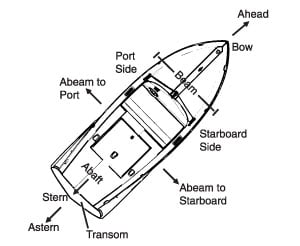
The front of a boat is called the bow, while the rear of a boat is called the stern. When looking towards the bow, the left-handed side of the boat is the port side. And starboard is the corresponding word for the right side of a boat. When moving to the front of a vessel, you are moving forward, when moving to the rear of a vessel, you are moving aft. When referring to the front left of a vessel, it is referred to as the port bow. When referring to the front right of the vessel, it is known as the starboard bow. When referring to the rear left of a vessel, it is known as the port quarter. When referring to the rear right of a vessel, it is known as the starboard quarter. When a vessel is in motion, it is known as being underway.
The front of a boat is called the bow, while the rear of a boat is called the stern. When looking towards the bow, the left-handed side of the boat is the port side. And starboard is the corresponding word for the right side of a boat. When moving to the front of a vessel, you are moving forward, when moving to the rear of a vessel, you are moving aft. When referring to the front left of a vessel, it is referred to as the port bow. When referring to the front right of the vessel, it is known as the starboard bow. When referring to the rear left of a vessel, it is known as the port quarter. When referring to the rear right of a vessel, it is known as the starboard quarter. When a vessel is in motion, it is known as being underway.

